Turkey’s democracy has died

Turkey’s Democracy Has Died (CNN)

April 2017

(CNN)Turkish President Recep Tayyip Erdogan has declared victory in a referendum over a new constitution that will make him far more powerful, potentially for many more years to come. The result, which the opposition is calling fraudulent, promises to make Turkey less democratic, more bitterly divided and more religious than ever.

It comes as no surprise that at the last minute, when the counting showed the “no” vote was threatening the thin lead of the pro-Erdogan “Yes” vote, electoral authorities stepped in to announce they would allow unsealed ballots to be counted, in contravention to the rules.

Already the lead-up to the vote gave enormous advantages to the yes camp, particularly in the form of media coverage. Meanwhile, opponents faced intimidation and the risk of job loss if they publicly voiced their opinions. Now, with the results showing a narrow 51%-to-49% victory for Erdogan, the opposition says the vote counting, too, was marred by fraud and vows to challenge it.

Still, it looks all but certain the President has won a historic victory that will not only transform the country he has led since 2013, but will also create a path for him to remain in office until 2029. Erdogan, a charismatic, authoritarian populist with an agenda steeped in Islam, has become the focal point of deep divisions in the country, and this referendum will make those divisions only more acrimonious and destabilizing.

With barely half the country supporting his push for more power, and with the three largest cities — Istanbul, Ankara and Izmir — voting no, Erdogan will assume his new powers under a cloud of doubt. That sense of insecurity is likely to make Erdogan more, not less, autocratic.

Erdogan has not been a conciliatory leader. Instead, he has ruled by stoking ideological, social and sectarian divisions. He has responded to challenges, even peaceful and democratic ones, by crushing the opposition. And he has taken advantage of every opportunity — and every challenge — to bolster his power.

No opportunity is greater than the one proffered by Sunday’s referendum. The referendum’s win approves a new constitution containing 18 amendments that will phase in gradually, turning Turkey’s parliamentary system into a presidential one.

Until now, the President was supposed to be a figurehead, unaffiliated with any political party and without great powers. Under Erdogan, that figurehead role was never real. But the new system will officially transform the ceremonial President into a commanding executive.

Erdogan, who has never lost an election, will resume his role as the leader of the Justice and Development Party, or AKP, which he founded and used as the vehicle for his meteoric rise from soccer player into Turkey’s most powerful leader in nearly a century.

He will lead the party that holds the majority in parliament, controlling both the legislative and executive branches, and soon strengthening his dominance over the judiciary. Checks and balances will fade away. New elections will be held in 2019, at which time the prime minister’s position will be abolished. By then, the President will be able to appoint 12 out of the top court’s 15 judges, select the members of the National Security Council and play a prominent role in drafting legislation.

Critics say Erdogan will, in effect, become a dictator. Erdogan never quite left the helm of AKP even as he transitioned into the presidency, and when he faced down an attempted overthrow last July, he used the opportunity to purge the country of anyone who might stand in the way of his political ambitions.

The 2016 coup attempt proved so useful to Erdogan that many still question if he didn’t orchestrate it himself.

Within hours of regaining power, he launched a crackdown of stunning magnitude, imprisoning tens of thousands of people, and removing hundreds of thousands from their jobs in the military, universities, courts and elsewhere.

The coup failed, and real democracy died in its wake. But long before the coup, Erdogan’s anti-democratic tendencies were already in stark display. Years before, Turkey had already imprisoned more journalists than any country, as it does today. And that was just one of the signs that liberal, pluralist democracy was not Erdogan’s cup of tea.

While much of the country still looked forward to seeing Turkey draw closer to the liberal, modern West and join the European Union, Erdogan fired up the crowds with nationalist, anti-Western rhetoric.

The President and his agenda are a big hit with about half the population, mostly the rural, conservative segments. But it is anathema to the other half. For urban Turks, and for others who still embrace the secularism of Kemal Ataturk, Erdogan’s conservative, religion-driven agenda is hard to stomach.

Worse yet, the President appears determined to challenge Kemalism with a new blend of nationalism and religion that puts him at the top. His new $600 million, 1,100-room presidential palace has become symbolic evidence for critics’ claims that he wants to be the new Sultan, reprising Ottoman glory days, when one man had full power and Turkey led the Muslim world.

Many worry about how far the President will go in pushing his socially conservative and religious views as he tries to reshape the country. Women were incensed when the President spoke of the “delicate nature” of women and declared that “Our religion [Islam] has defined a position for women: Motherhood.”

But perhaps nothing puts the Islamization agenda in sharper focus than the government’s education plans for a country in which secularism was a central tenet. Erdogan has said he wants to raise a “pious generation,” and the education ministry has announced a new curriculum that includes massive amounts of religious text, and a heroic depiction of Erdogan’s win against the July coup plotters.

What lies ahead for the divided Turkish people is a much more intense Erdogan era. The President will now be empowered to move forward with his plan to erode secularism and consolidate his own power.

For those who want Turkey to continue on the path of a democracy, with rule of law, independent judges, free expression and equality for all, the road ahead just became much, much steeper.

Curried Sausages

Ingredients

  • 8 sausages (beef, chicken, lamb or pork sausages)
  • 1 tbsp oil
  • 2 onions
  • 2 garlic cloves
  • 1 tbsp grated fresh ginger
  • 2 carrots, quartered, then cut into 1/2 in chunks
  • 2 potatoes, diced
  • 1 tbsp curry powder
  • 2 tbsp tomato paste
  • 2 tbsp fruit chutney
  • 1/2 cup apple  sauce
  • 1 cup chicken stock chicken stock
  • 400ml can coconut milk
  • 1 cup frozen peas (optional)
  • salt and pepper

DIRECTIONS

  1. Cover the sausages with cold water; bring to the boil and simmer about 5 minutes.
  2. Drain, cool, remove skins and cut each into 4 or 5 pieces.
  3. Heat the oil in a large saucepan and fry the onion, garlic and ginger, carrots and potatoes, stirring until the onions are soft. Add the curry powder and cook a minute or two.
  4. Add the tomato paste, chutney, apple sauce, stock and coconut milk. Stir well, then return the sausage chunks to the saucepan.
  5. Bring too the boil then cover and simmer about 45 minutes. Remove the lid and allow to cook about 15 minutes more to reduce the sauce a bit. If you can’t be bothered, mix two tablespoon cornflour (corn starch) with 2 tablespoons water and stir this through to thicken.
  6. 1 cup of peas can be added in the last 15 minutes as well.
  7. Season with salt and pepper and serve garnished with copped fresh coriander.

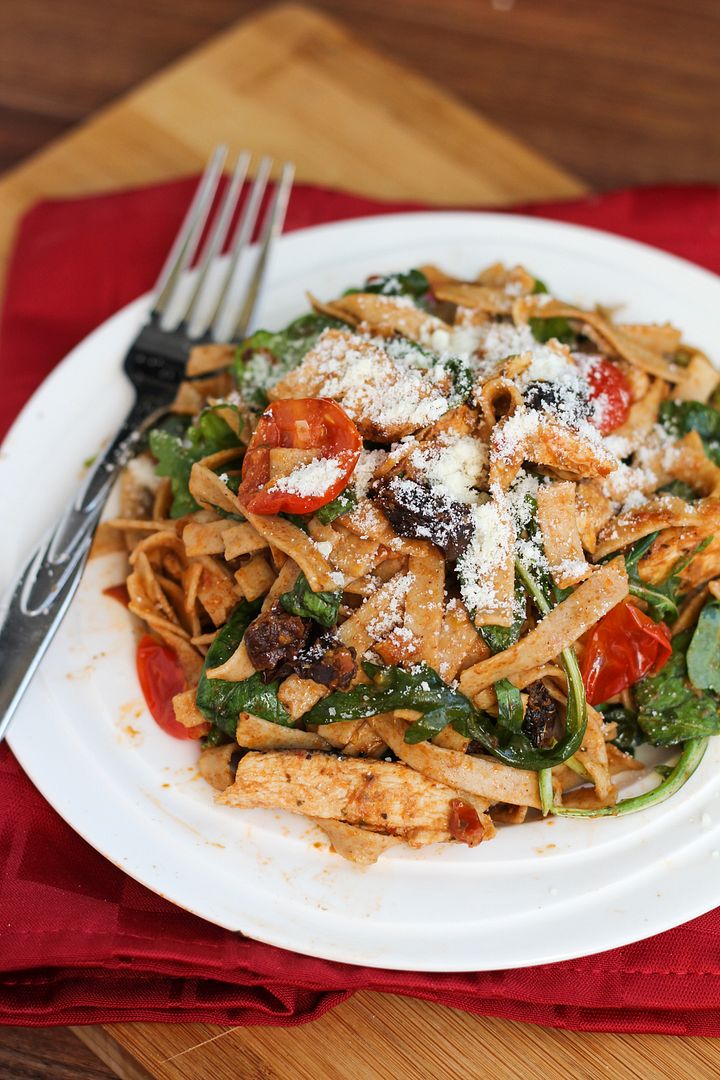
Sundried Tomato Pesto Pasta with Chicken, Spinach, & Tomatoes

Source: http://www.onceuponacuttingboard.com/2014/07/sundried-tomato-pesto-pasta-with.html

Serves 4-6

Ingredients

  • 2 boneless skinless chicken breasts
  • 85g sundried tomatoes – dry in a bag (not oil packed)
  • 350g package of whole wheat pasta – I used fettucine
  • 2 teaspoons olive oil
  • 2-3 cloves of garlic, minced
  • 250g grape tomatoes, halved
  • 1/2 cup sundried tomato pesto
  • 150g baby spinach
  • Parmesan cheese for topping

Method

  1. Season chicken breasts, if desired (I used salt, pepper, and dried basil) and cook however you prefer. I saute mine in a skillet over medium-high heat for about 5 minutes per side, let rest, then slice.
  2. Meanwhile, bring a large pot of water to a boil.
  3. Add sundried tomatoes and blanch for 2 minutes.
  4. Remove with a slotted spoon, let dry, and thinly slice.
  5. Use the same boiling water to add your pasta and cook according to package directions.
  6. Reserve 1 cup cooking water then drain pasta. While pasta is cooking, heat oil in a large skillet over medium-high heat.
  7. Add garlic and grape tomatoes and sautee until softened, about 5 minutes.
  8. Toss together the pasta, reserved cooking water, pesto, chicken slices, garlic & tomatoes, and sundried tomatoes.
  9. Stir in the spinach so it gets slightly wilted. Season the dish with salt and pepper if desired.
  10. Serve hot, topped with parmesan cheese.

Low Hassle Brunch Feast

Source: The Guardian

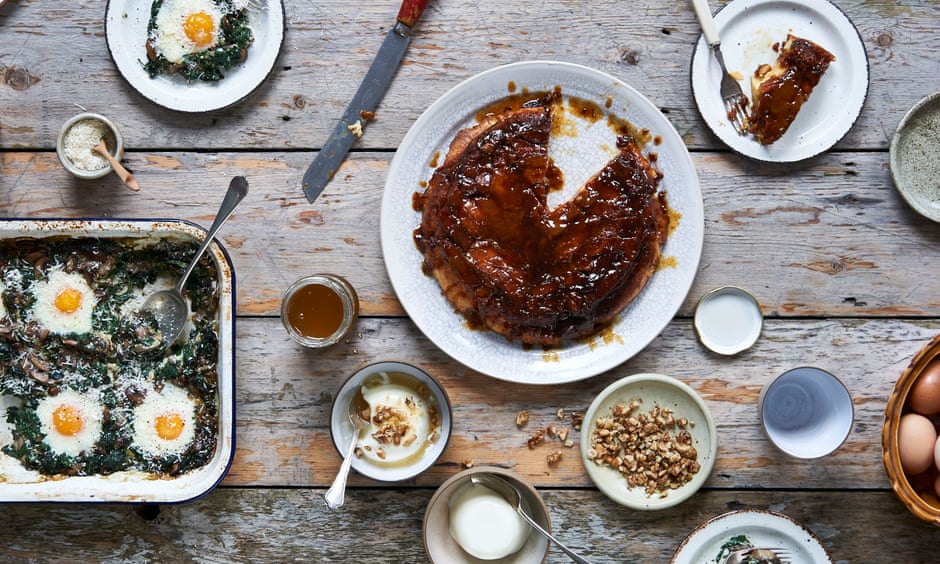
There is a rule when hosting brunch: avoid cooking on the day. Prep these recipes for eggs baked in spinach, salted caramel bread pudding and yoghurt panna cotta in advance, and your Easter weekend will be off to a winning start …
For someone who has no belief-based obligation to host an Easter brunch this weekend, I sure have a lot of strong opinions on how to best cook one, and that’s mostly because brunch parties are much more fun than dinner parties. From late morning to midday, we are all bright-eyed and better-rested, our homes are filled with sunlight, the coffee is free-flowing and no matter how long it goes on, even if everyone overstays, you’re still going to have an empty home by dinnertime.
My essential rule for hosting brunches is to sleep in, and barely to cook at all on the day. By focusing on recipes that can either be prepped the day before or become better after some time to rest, hosting a brunch becomes almost as luxurious as attending one. My favourite breakfast casserole bakes a dozen eggs in nests of creamed spinach, mushrooms and parmesan that looks, coincidentally, a lot like an Easter basket. It’s also gluten-, grain- and meat-free, so it accommodates all sorts of diets, and I get everything done the night before so all I have to do is crack in some eggs and turn on the oven in the morning. A panna cotta made with Greek yoghurt and finished with walnuts and honey is just a little sweet, but still decadent. You can serve it in wedges or individual cups and you can make it even two days in advance. Finally, the icing on the cake (or, forgive me, the sauce on the pudding) is a stunning upside-down salted caramel bread pudding that’s basically like the lovechild of french toast and a tarte tatin., which you will have no choice but to make for every brunch you ever host after this, because your friends and family will insist. Please, consider yourself warned.

Baked eggs with spinach and mushrooms

Serves 6-12

Ingredients

  • 1kg spinach, washed
  • 4 tbsp unsalted butter
  • 1 onion, finely chopped
  • 3 garlic cloves, minced
  • 500g mushrooms, thinly sliced
  • 225g whipping cream
  • ¾ tsp salt
  • Freshly ground black pepper
  • ¼ tsp nutmeg, grated (optional)
  • 12 large eggs
  • 6 tbsp parmesan, finely grated

Method

  1. Bring 7mm water to a boil in a large ovenproof frying pan. Add half the spinach and cook, turning, until wilted – about 30 seconds. Add the remaining spinach and wilt. Cook, covered, over a moderately high heat until tender – just 1-2 minutes. Drain and cool under cold running water. Gently squeeze to remove as much liquid as possible, then coarsely chop.
  2. Wipe the pan dry, then melt the butter over a medium-low heat. Cook the onion and garlic for 2-3 minutes, or until softened. Add the mushrooms, raise the heat to medium-high, for about 5 minutes or until softened.
  3. Stir in the cream, salt, pepper, nutmeg (if using), and the chopped spinach and bring back to a simmer. Remove the pan from the heat.
  4. When you’re ready to bake, about 30 minutes before serving, heat the oven to 230C/450F/gas mark 8.
  5. Put the spinach mix in a baking dish – or use your pan if ovenproof – and make 12 wells in it. Crack an egg into each. Bake at the top of the oven until the whites are firm and yolks are still runny – 15-30 minutes depending on ovens and baking vessel. It’s better to have to check more often than to let them overcook. It is nearly impossible to get all 12 eggs to cook evenly. The ones in the centre will be more runny; at the edges, they’ll be more firm. But don’t fret. I’ve found that almost all people have an egg preference (more runny vs. more firm) and each egg manages to find the right home. Just ask people their preference as you serve them.)
  6. Sprinkle with salt and pepper and grated parmesan before serving.

Morning bread pudding with salted caramel

Serves 6-10

This recipe is from none other than Food52 co-founder Amanda Hesser. It is an overnight dish, ideally. Set it up before you go to bed and all you have to do when you wake up is bake it and invert it on to a serving dish. The longer it soaks, the more the bread and custard become one, but I think as long as it has an hour to soak, it will be good enough.

Ingredients

  • 170g sugar plus 2 tbsp extra (optional)
  • 6 tbsp unsalted butter
  • 2-3 pinches salt
  • 300-350g brioche loaf or challah bread (cut into 7mm-thick, 8cm-wide slices)
  • 8 large eggs
  • 60g mascarpone, plus more for serving
  • 250ml milk
  • ¼ tsp almond extract

Method

  1. Combine the sugar, butter and salt over a medium heat for 7-10 minutes, until the sugar dissolves and begins to brown. Reduce the heat to medium-low, stir with a spatula so that it browns evenly. You will find that the butter separates from the melting sugar and this is just fine. Your caramel is done when it reaches a copper colour.
  2. Pour over the base of a 2-litre oval gratin/roasting dish, or deep-dish pie pan. Transfer to the fridge until the caramel is cold and solid – about 30 minutes. Once chilled, arrange the bread slices around the dish with the heels in the centre and overlapping slightly.
  3. Whisk together the eggs, 2 tbsp sugar (if using) and the mascarpone until very smooth. Add the milk and almond extract. Pour over the bread; saturate all of it. Cover tightly with plastic wrap and chill overnight. If your bread seems too high in the vessel to get a good soak, you can weight it with a plate in the fridge.
  4. Take your dish from the fridge 1 hour before you want to bake it. Set the oven to 190C. Bake for 30-35 minutes, until moist, but not wet in the centre.
  5. Run a knife around the edge of the dish, to loosen. Place a serving plate over the top of the dish and flip. Serve, cutting it into wedges at the table and spooning a healthy dollop of mascarpone on to each plate.

Yoghurt panna cotta with honey and walnuts

As far as panna cottas go, this is on the soft side but will still slice or hold form.
Serves 7-8

Ingredients

  • Flavourless oil, such as sunflower
  • 4 tbsp water
  • 2 ½ tsp plain gelatin (or vegetarian equivalent)
  • 460g Greek yoghurt
  • 475ml milk or whipping cream (or a mix of the two)
  • 50-100g granulated sugar
  • Juice of ½ a lemon
  • Honey, to serve
  • A big handful of walnuts, toasted,cooled and coarsely chopped

Method

  1. If you plan to unmould the panna cotta, coat a 25cm round cake pan or smaller dessert cups with a little oil.
  2. Put the water in a small bowl. Stir in the gelatin and set aside until it has softened – about 15 minutes.
  3. Whisk together all of the yoghurt and 250ml of the milk, cream or mixture thereof. Bring the remaining milk or cream and sugar to a simmer. Stir in the water-gelatin mixture (it will dissolve immediately) and remove from heat. Whisk this mixture into the yoghurt mixture, then stir in the lemon juice at the end.
  4. Pour the mixture into the cake pan or smaller cups, then chill in the fridge for at least 2 hours for small cups and up to 8 for a large pan. It’s best to do this the night before you need it, to be safe.
  5. To unmould the cake pan, fill a larger baking dish with 3cm boiling water. Dip the pan in it for 10 seconds, then flip it out on to a flat, round plate. (A curved one will cause the panna cotta to appear sunken in the middle.)To unmold smaller dishes, bring a small saucepan of water to a simmer and dip the bottom of a small panna cotta cup in one for five seconds, then invert it on to a plate. Repeat with remaining cups.
  6. Right before you serving, sprinkle the panna cotta with walnuts and drizzle it with honey. This needs to be done right before you serve it, because the honey will (unfortunately) become liquidy and roll off if it, should it sit on the panna cotta for too long.

Scones

Ingredients

  • Plain flour, for dusting
  • 3 cups self-raising flour
  • 80g butter, cubed
  • 1-1 1/4 cups milk
  • Jam and whipped cream, to serve

Method

  1. Preheat oven to 200deg c.
  2. Lightly dust a flat baking tray with plain flour.
  3. Sift self-raising flour into a large bowl.
  4. Using your fingertips, rub butter into flour until mixture resembles breadcrumbs.
  5. Make a well in the centre. Add 1 cup of milk. Mix with a flat-bladed knife until mixture forms a soft dough, adding more milk if required. Turn onto a lightly floured surface. Knead gently until smooth (don’t knead dough too much or scones will be tough).
  6. Pat dough into a 2cm-thick round. Using a 5cm (diameter) round cutter, cut out 12 rounds. Press dough together and cut out remaining 4 rounds. Place scones onto prepared baking tray, 1cm apart.
  7. Sprinkle tops with a little plain flour.
  8. Bake for 20 to 25 minutes or until golden and well risen.
  9. Transfer to a wire rack.
  10. Serve warm with jam and cream.

Hollandaise Sauce

From: http://www.foodnetwork.com/recipes/tyler-florence/hollandaise-sauce-recipe.html

Ingredients

  • 4 egg yolks
  • 1 tablespoon freshly squeezed lemon juice
  • 1/2 cup unsalted butter, melted (1 stick)
  • Pinch cayenne
  • Pinch salt

Method

  1. Vigorously whisk the egg yolks and lemon juice together in a stainless steel bowl and until the mixture is thickened and doubled in volume.
  2. Place the bowl over a saucepan containing barely simmering water (or use a double boiler,) the water should not touch the bottom of the bowl. Continue to whisk rapidly.
  3. Be careful not to let the eggs get too hot or they will scramble.
  4. Slowly drizzle in the melted butter and continue to whisk until the sauce is thickened and doubled in volume.
  5. Remove from heat, whisk in cayenne and salt.
  6. Cover and place in a warm spot until ready to use for the eggs benedict.

If the sauce gets too thick, whisk in a few drops of warm water before serving.

Best Banana Muffins

Ingredients

  • 2 large or 3 small bananas
  • 1/2 cup sugar
  • 1/2 cup oil
  • 1 cup mashed banana
  • 1 egg
  • 1 tsp vanilla essence
  • 1/2 cup All Bran (Kellogg’s)
  • 1/3 cup chopped raisins/choc chips
  • 1/2 cup plain flour
  • 1/2 cup plain wholemeal flour
  • 1 tsp baking powder
  • 1 tsp bicarb soda

Method

  1. Spray or grease 12 muffin pan
  2. Heat oven (180 C)
  3. Combine sugar, oil, banana, egg, vanilla and All Bran. Let it stand for 5 mins
  4. Add raisins/choc chips, sifted flour, baking powder, & soda to wet mixture
  5. Stir with fork until ingredients are just combined (don’t over-stir)
  6. Spoon into prepared muffin trays
  7. Bake approx 20 mins or until golder brown
  8. Sprinkle with icing sugar

Fritters

Corn Fritters

Ingredients

  • 1 egg
  • 1cup creamed corn
  • 1 tsp sugar
  • 1/2 cup plain flour
  • 1 tsp baking powder
  • Pepper to taste
  • Chopped parsley or chives (optional)

Method

  1. Beat the egg and mix in the corn and seasoning. Stir in the flour and BP sifted together. Stir just enough to mix the ingredients (The mixture should have the consistency of batter. Add a little milk if too thick).
  2. Fry in 1 to 2 tablespoon amounts in hot (as for pan cakes) oiled pan 2 mm of oil till golden then flip and cook the other side. Test for doneness. Nice served with bacon and /or tomato relish.

Potato & Corn Fritters

Lunch for 4 hungry people

Ingredients

  • 1kg potatoes grated
  • Chopped herbs (optional)
  • 3-4 large eggs
  • 1 cup grated cheese
  • 1 can creamed corn
  • half an onion, finely chopped (optional)
  • 3 tablespoons of S/R flour

Method

  1. Squeeze any liquid from grated potato and pour off. Place in bowl with chopped herbs.
  2. Add all other ingredients and combine.
  3. Season with the salt and pepper
  4. Heat oil in frying pan. Drop tablespoons of mixture into frying pan flattening slightly to even thickness.
  5. Cook each side 2-3 minutes till golden brown and crisp.
  6. Place on paper towels to soak up excess oil.

Feta Muffins

INGREDIENTS

  • Canola oil, to grease
  • 375g (2 1/2 cups) self-raising flour
  • 250g (about 1/2 bunch) English spinach,trimmed, washed, dried, shredded
  • 150g feta, crumbled
  • 110g (1/2 cup) chopped semi-dried tomatoes
  • 2 tablespoons finely grated parmesan or vegetarian hard cheese
  • 330ml (1 1/3 cups) milk
  • 90g butter, melted
  • 1 egg
  • 1 tablespoon chopped fresh dill
  • 2 tablespoons finely grated parmesan or vegetarian hard cheese, extra

METHOD

  • Step 1 Preheat oven to 200°C. Brush twelve 80ml (1/3-cup) muffin pans with canola oil to lightly grease.
  • Step 2 Sift flour into a bowl. Add shredded spinach, feta, tomatoes and parmesan, and stir to combine. Use a fork to whisk together milk, butter, egg and dill until well combined. Add milk mixture to flour mixture and use a metal spoon to stir until just combined (do not over mix).
  • Step 3 Spoon mixture into prepared pans. Sprinkle with extra parmesan. Bake for 20 minutes or until a skewer inserted into the centre comes out clean. Turn out onto wire rack to cool. Serve warm or at room temperature.