The explosive rise of Turkey’s economy in the past decade is one of the most fascinating growth stories of all time. Since 2002, Turkey’s economy nearly quadrupled in size on the back of an epic boom in consumption and construction that led to the building of countless malls, skyscrapers, and ambitious infrastructure projects. Like many emerging economies in the past decade, Turkey’s economy continued to grow virtually unabated through the Global Financial Crisis, while most Western economies stagnated. Unfortunately, like most emerging market nations, Turkey’s economic boom has devolved into a dangerous bubble that is similar to the bubbles that caused the downfall of Western economies just six years ago. Though Turkey has received significant attention after its currency and financial markets fell sharply in the past year, there is still very little awareness of the country’s economic bubble itself and its frightening implications.
Turkish flag (Photo credit: quinn.anya)
The emerging markets bubble began in 2009, shortly after China pursued an aggressive credit-driven infrastructure-based growth strategy to boost its economy during the global financial crisis. China’s economic growth immediately surged as construction activity increased dramatically, which drove a global raw materials boom that created a windfall for commodities exporting countries such as Australia and emerging markets. Emerging markets’ improving fortunes began to attract the attention of global investors who were seeking to diversify away from Western nations that were at the epicenter of the financial crisis. As the bubble progressed, even developing countries that were not significant commodities exporters (such as Turkey) began to benefit from the growing interest in this investment theme. Rock-bottom interest rates in the U.S., Europe, and Japan, combined with the U.S. Federal Reserve’s multi-trillion dollar quantitative easing programs, encouraged a $4 trillion torrent of speculative “hot money” to flow into emerging market investments over the last several years. A global carry trade arose in which investors borrowed at low interest rates from the U.S. and Japan, invested the funds in high-yielding emerging market assets, and pocketed the interest rate differential or spread. Soaring demand for EM assets led to a bond bubble and ultra-low borrowing costs, which resulted in government-driven infrastructure booms, alarmingly fast credit growth, and property bubbles in numerous developing nations. Like many other emerging nations, Turkey’s economic boom since the financial crisis has been heavily predicated upon a combination of foreign “hot money” inflows, ultra-low interest rates across the yield curve, rapid credit growth, and soaring asset prices. The charts of Turkey’s benchmark interest rate and three-month interbank rate show how they were cut to all-time lows in the years following the financial crisis:
Turkey’s idiosyncratic monetary policy of the past half-decade was responsible for these unusually low interest rates: Recep Tayyip Erdoğan, Turkey’s Prime Minister, believes that a zero real interest rate policy is the best practical implementation of sharia law’s ban on usury, or lending for interest, for modern Islamic societies. “We aim to cut the real interest rate in the long run, so people will increase their incomes through working, not through interest,” he said in 2011. “Eventually we aim to equalize the interest rate and inflation rate.” Turkey’s Economic “Miracle” Is Driven By A Credit Bubble Ultra-low interest rates are, of course, notorious for creating temporary economic booms that are driven by credit and asset bubbles – a fact that likely wasn’t lost on Erdoğan, who vowed to make Turkey one of the world’s ten largest economies by 2023. Loans to Turkey’s private sector have more than quadrupled since 2008, even though the country’s real GDP only increased by approximately a third (and a good portion of that GDP increase was driven by debt): Turkey’s M3 money supply – a broad measure of total money and credit in the economy – shows a similar ominous increase: The emerging markets bond bubble enabled a corporate borrowing spree that caused Turkey’s external debt, or debt owed to foreign creditors, to surge to a record high of U.S.$372.6 billion or nearly 47 percent of the country’s GDP:
Continued from page 1 90 percent of Turkish corporate debt is denominated in foreign currencies, which dangerously exposes the country’s corporate borrowers to weakness in the Turkish lira currency, which is down by over 18 percent against the U.S. dollar in the past year: Even more worrisome is the fact that U.S. $129.1 billion, or just over a third, of Turkey’s external debt is short-term debt that will come due in the next year, which is a sharp increase from the country’s short-term external debt of U.S. $100.6 billion at the end of 2012, and U.S. $52.52 billion external debt in 2008. Turkey’s short-term and long-term external debt have both increased at a faster rate than economic growth in the past half-decade. Having a large stock of short-term external debt makes economies more vulnerable to rising interest rates, as many emerging market nations have experienced in the past year after the U.S. Federal Reserve’s QE taper plans surfaced. Turkey’s short-term external debt burden exceeds 100 percent of its currency reserves, making it one of the highest risk emerging economies based on this metric. One of the reasons for Turkey’s rapid accumulation of external debt in the past decade has been the need to finance its growing current account deficit, which the country’s economy has become increasingly reliant upon to continue growing: Turkey’s current account deficit to GDP ratio has swelled to over 6 percent – a level that has led to currency crises in the past: Turkey’s Consumption Boom Is Actually A Bubble Accounting for 70 percent of Turkey’s GDP, consumer spending has been the country’s primary engine of economic growth in the past decade. Unfortunately, much of this consumer spending has been financed by debt, as with many other areas of Turkey’s economy. Personal loans grew at a scorching 61 percent average annual rate from 2005 to 2008 and barely slowed down after the financial crisis, while loans to households were increasing at a 28 percent annual rate in 2013. Credit is so free-flowing in Turkey that consumers are even able to receive approvals for personal loans via text message and ATM machines. In addition to personal loans, credit card debt has played a significant role in enabling Turkey’s consumption boom, with credit card loans from the country’s leading banks having risen by 77 percent from 2010 to mid-2013. Turkey’s 74 million citizens now own 57 million credit cards and carry approximately $45 billion in outstanding credit card debt – nearly a third of which is considered to be nonperforming. Turkish consumers’ embrace of debt-driven consumption has caused household debt as a proportion of disposable income to rocket from 4.7 percent in 2002 to 50.4 percent in 2012. As is common in low interest rate and credit bubble environments, Turkey’s consumption boom has been abetted by a savings rate that has fallen to its lowest level in at least three decades, which places Turkey dead last among fourteen other developing countries for this metric. An IMF study found that the average developing country has a savings rate of 33.5 percent, which is nearly triple Turkey’s 12.6 percent savings rate. The combination of Turkey’s falling savings rate and credit binge has helped to propel the country’s consumer spending to an all-time high in the past decade: Turkish consumers have focused much of their discretionary spending on goods such as automobiles, consumer electronics, and household appliances. Numerous foreign multinational corporations have flocked to Turkey to profit from the country’s spending boom. Turkey Has A Property Bubble Like many other emerging market nations, Turkey’s frothy, low interest rate environment of the past half-decade has led to the inflation of property bubbles in major urban centers. Turkish housing prices have soared by nearly 53 percent since 2009: Source: GlobalPropertyGuide.com Turkey’s property bubble was driven by mortgage interest rates that have plunged from nearly 50 percent in 2002 to under 10 percent in 2013, which led to a more than sixfold increase in the country’s total outstanding mortgage loans since 2005: Turkey’s ballooning mortgage bubble – which expanded by 28 percent last year alone – helped to finance a 78.7 percent increase in property sales in 2013, which has led to a bubble in residential construction activity in turn. Construction Plays A Key Role In Turkey’s Bubble Construction is one of the most common drivers of economic activity during bubbles, and Turkey’s bubble economy is no exception to this pattern. Now accounting for $170 billion or approximately 20 percent of Turkey’s $789.3 billion economy (when including related activities), construction of all types have been booming, particularly construction of residential buildings, malls, hotels, skyscrapers, airports and other massive infrastructure projects. Growing by 42.9 percent in 2013, construction-related loans are a major component of Turkey’s overall credit bubble. Since 2008, 39 new skyscrapers have been completed in Turkey, and there are 42 more skyscrapers currently under construction. After its completion in 2011, the 856-foot tall Istanbul Sapphire became both Turkey and Europe’s tallest building outside of Russian territory. Turkey’s skyscraper construction frenzy is a reason for alarm according to the Skyscraper Index, which posits that many of history’s worst economic crises – including the Great Depression and 1997 Asian financial crisis – were preceded by the building of record-breaking skyscrapers.
Sapphire Tower – the tallest building in Istanbul (Photo credit: Charkrem) Skyscraper booms and economic bubbles go hand-in-hand because excessive optimism combined with the availability of cheap credit leads to wildly ambitious, “pie in the sky” business decisions that are later regretted when the boom inevitably turns into a bust. Turkey’s skyscraper mania is funded in large part by the risky short-term U.S. dollar-denominated loans that were discussed earlier. Property development conglomerate Kiler Group – which owns the Istanbul Sapphire – had 164 million liras worth of debt in 2013, 154 million liras of which are U.S. dollar-denominated loans. Property development firms that have large amounts of dollar-denominated loans are dangerously exposed to adverse moves in the Turkish lira’s exchange rate against the U.S. dollar. Shopping mall development is another important facet of Turkey’s construction bubble: Turkey had only 46 malls in 2000, but now has over 300, and there are plans to build at least 300 more in the next decade. 1.5 million square meters of shopping space is expected to come online in 2014, representing an 18 percent increase in Turkey’s total shopping mall space. Turkey’s mall construction bubble is being encouraged by the country’s unsustainable credit-driven consumer spending boom that was discussed earlier. As with malls, there has been an explosion of new hotels built in Turkey in the past decade, and many more are in the pipeline. In the next three years, 65 new four and five star hotels with a total number of 38,853 beds are expected to be completed. Western hotel companies have been clamoring to get a piece of the hotel bubble action: Hilton Worldwide had 20 hotels under construction in 2013, Radisson has 15 Park Inn properties planned, while Wyndham has 9 more Ramadas, an additional Wyndham, and 20 Super 8 hotels planned, to name just a few examples. According to Mehmet Onkal of BDO Hospitality Consulting, 95 percent of Turkey’s hotel projects are funded by local investors. Ambitious government-led infrastructure projects have been a significant driver of Turkey’s construction activity and economic growth as well. Prime Minister Recep Tayyip Erdoğan is the mastermind behind Turkey’s decade-long, $200 billion construction plan that includes mega projects such as:
A third airport in Istanbul that is expected to be one of the world’s largest when it opens in 2019. Costing an estimated $29 billion, this is currently Turkey’s most expensive mega project
A 26-mile shipping canal to link the Marmara and the Black Sea, which is expected to cost $15 billion
A 24-tower public-private real estate development that will contain approximately 5,000 luxury apartments, at a cost of $8.4 billion
A $5 billion rail tunnel that will run under the Bosporus
A third bridge across the Bosporus that will cost $4.4 billion
A $2.6 billion financial center complex for the central bank, financial regulators, and private financial firms
A $2.5 billion luxury high-rise that includes a hotel, a new mall, office space, and a spacious performing arts center
A large new tunnel under the Bosporus that will cost $1.4 billion
A $1.35 billion development with two marinas, two five-star hotels, a massive mall, and a 1,000-capacity mosque
A $700 million ship port, along with luxury hotels and offices
A $180 million luxury hotel and office skyscraper called the Diamond of Istanbul that will replace the Istanbul Sapphire as Turkey’s tallest building when completed
Public construction projects are the primary reason why Turkey’s government spending has increased by nearly two-thirds in the past decade: Turkey’s construction boom has been rife with corruption and scandals involving allies of Prime Minister Recep Tayyip Erdoğan. On December 17th 2013, news of a 15-month secret investigation broke that led to the arrest or questioning of over 100 people. Among those people were sons of three of Erdogan’s cabinet ministers, the CEO of a state-run bank, and a construction tycoon who has become one of the wealthiest men in Turkey thanks to the country’s bubble economy of the past decade. The allegations against those arrested range from taking bribes to bid rigging. Millions of dollars in cash have been found in some of the homes of the accused. Erdoğan dismissed the criminal investigations of his allies as a plot by foreign interests to hamper and detract from Turkey’s economic boom. Turkey’s Bubble Has Created An Illusion Of Prosperity Turkey’s inflating bubble economy has helped the country’s GDP to nearly quadruple in a little over a decade: Source: World Bank Turkey’s stock market soared by ninefold from 2003 to its peak in early 2013, and is still up by sixfold despite the recent market rout: Booming stock and property prices have led to a surge in the number of wealthy Turks since 2002, including a 10.5 percent increase in the number of ultra-wealthy individuals with net assets of $30 million and above in 2013. Turkey now has the world’s seventh highest number of billionaires according to Forbes’ billionaire list. Many of Turkey’s new billionaires hail from the finance and construction sectors, which are typical epicenters of wealth generation during credit-driven economic bubbles. Though traditionally an emerging market, Turkey’s frothy economic boom has recently led to its reclassification as a newly industrialized country by economists and is considered to be a developed country by the CIA. Turkey is a member of the MINT, CIVET, and Next Eleven groups of emerging economies that are being touted as the next BRICs, which is an acronym for Brazil, Russia, India, and China. Many of the countries in the aforementioned groups are experiencing economic bubbles of their own and are part of the overall emerging markets bubble. Cracks Are Beginning To Show Turkey’s economy and financial markets were sailing fairly smoothly until a perfect storm of events in late-May 2013 caused a change of sentiment virtually overnight. From late-2012 until May 2013, Turkey’s financial markets had levitated on a new wave of liquidity that was provided by the U.S. Federal Reserve’s $85 billion per month QE3 program and Japan’s new Abenomicsstimulus program. In the spring of 2013, rumors of an upcoming tapering or downsizing of the Fed’s QE3 program began to put global financial markets on edge – particularly those that were the greatest beneficiaries of the Fed’s liquidity such as emerging markets and bonds. With markets already uneasy over QE3 taper rumors, one catalyst was all that was needed to send Turkey, and soon the rest of emerging markets, reeling: a wave of protests and riots began in Turkey on May 28th 2013 over a slew of discontent that had built up despite the country’s booming economy. Often compared to the Occupy protests and movement, Turkish protesters expressed their dismay over numerous environmental issues that resulted from the country’s construction boom, excessive use of police force, the lack of freedom of speech and right to assembly, government encroachment of the country’s secularism, and Prime Minister Recep Tayyip Erdoğan’s authoritarianism. 3.5 million of Turkey’s 80 million people took part in the protests, which resulted in 11 deaths, over 8,000 injuries, and more than 3,000 arrests.
Protests in Istanbul (Photo credit: Daniel Etter/Redux) The combination of QE3 taper speculation, the persistent current account deficit, and civil unrest, led to a sharp loss of confidence that caused Turkey’s stock market to plunge by over 25 percent in just one month, sparked a selloff in the Turkish lira currency, and caused 10 year Turkish government bond yields to spike from 6 percent to 10 percent. I predicted the turmoil in Turkey and other emerging markets just a few months before it started in a report that I wrote when I was a contributor to Business Insider called “All The Money We’re Pouring Into Emerging Markets Has Created a Massive Bubble.” Turkey’s financial markets stabilized after their spring rout until December 2013, when the country’s corruption scandal came to light and the Fed’s imminent QE taper caused the Turkish lira to crash by over 12 percent to a record low against the U.S. dollar, bringing the currency’s total loss for the year to nearly 22 percent: Turkey’s latest turmoil led to its categorization as one of the “Fragile Five” emerging economies, which also includes South Africa, Brazil, Indonesia, and India. The Fragile Five experienced the most pain among emerging markets since the spring 2013 because of their large current account and trade deficits, high inflation, significant dependence on foreign capital inflows, and slowing economic growth. To shore up Turkey’s currency after its sharp decline, Prime Minister Erdoğan was finally forced to give in to the demands of a group of Turkish leaders that he called the “interest rate lobby” that he had long battled against due to their calls for higher interest rates. On January 28th 2014, Turkish Central Bank Governor Erdem Basci – a member of the so-called “interest rate lobby” – surprised the world when he ordered dramatic hikes of the overnight lending rate from 7.75 to 12.5 percent, the overnight borrowing rate from 3.5 percent to 8 percent, and the benchmark one-week repurchase rate from 4.5 percent to 10 percent: The World Is Still Unaware Of Turkey’s Economic Bubble Though Turkish and international financial markets initially cheered January’s surprise rate hikes, I view this as evidence that the world is still unaware that Turkey’s economic boom is actually a credit-driven bubble that is predicated on ultra-low interest rates, both foreign and domestic. Falling interest rates helped to inflate Turkey’s bubble economy, and rising interest rates will put an end to it. This is a very simple concept, yet so few people understand it – even after the events of 2008. I see even more evidence that the world is largely unaware of Turkey’s economic bubble in the fact that the vast majority of the recent discourse about Turkey’s problems is myopically focused on the country’s current account deficit and currency weakness, while virtually ignoring the risks posed by the eventual popping of Turkey’s credit bubble. I believe that this myopia is caused by denial of the existence of Turkey’s economic bubble in the first place, along with a mental block that is causing economists and commentators to focus too much on a 1997-style currency crisis, as if that is the only possible template for emerging market crises to follow. It is important to remember that history doesn’t repeat itself, but it does rhyme. The popping of the overall emerging markets bubble will cause a very severe global economic crisis, but it is wrong to expect this crisis to play out identically to the 1997 Asian financial crisis. Like snowflakes, no two economic crises are the same. Contrary to popular belief, Turkey’s currency weakness is not a new phenomenon, as it has been a consistent trend for the last six years: Despite the Turkish lira’s downtrend of the past six years, Turkey’s credit and asset bubble has continued to inflate to dizzying new heights, as it has also done since the spring 2013 panic. I am certainly not denying the risks posed by the Turkish lira’s rout, but I do not believe that Turkey’s economic bubble has truly popped yet. The lira’s weakness is the precursor to Turkey’s coming economic bust, but it is not “The Crisis” in and of itself. Lack of awareness and understanding of the implications of Turkey’s credit-driven bubble economy is the reason why most mainstream economists and commentators are still relatively optimistic on the country’s long-term economic prospects, even if they concede that growth will slow. Unfortunately, credit bubbles of the magnitude of Turkey’s do not end in a mere economic slowdown, but in a crisis. How Turkey’s Economic Bubble Will Pop Turkey’s economic bubble is likely to pop as a result of rising short and long-term interest rates, and may coincide with the popping of the overall emerging markets bubble. As the U.S. Federal Reserve follows through with its QE taper – which is expected to be completed this year – the flow of “hot money” to emerging markets will reverse, which will cause those countries’ currencies to decline and bond yields to climb. Turkey’s $129.1 billion short-term external debt that will come due over the next year is an additional related catalyst that will likely contribute to the popping of the country’s bubble. Here is what to expect when Turkey’s economic bubble truly pops:
The country’s runaway credit boom will turn into a bust
Countless construction and property development projects will turn sour
Many banks and property developers will go under
Many corporations that have large foreign currency debts will default
Over-leveraged consumers will default on their debts
Economic growth will go into reverse
Unemployment will surge
Government and corporate debt downgrades by rating agencies
Property, the lira currency, stock, and bond prices will fall significantly, leading to higher interest rates
Political backlash against the current leaders and more public protests
Credit-driven construction and consumption have been Turkey’s two main engines of economic growth in the past decade, and the inevitable ending of those unsustainable booms will leave the country without a viable source of growth. The popping of the overall emerging markets bubble will likely lead to a crisis that is worse than the 1997 Asian financial crisis because more countries are involved (Latin America, China, and Africa) this time, and because the global economy is in a much weaker state now than it was during the booming late-1990s. I will end this report with my favorite quote from economist Ludwig Von Mises:
“There is no means of avoiding the final collapse of a boom brought about by credit expansion. The alternative is only whether the crisis should come sooner as a result of a voluntary abandonment of further credit expansion, or later as a final and total catastrophe of the currency system involved.”
An increasingly autocratic prime minister is losing touch with voters and damaging his country
RECEP TAYYIP ERDOGAN has reason to thank Vladimir Putin. For weeks the Russian president’s attack on Ukraine has hogged headlines. This has let Turkey’s prime minister get away with only limited international opprobrium for a string of illiberal laws that seem designed mainly to protect himself and his allies from a corruption scandal that one insider calls the biggest in modern Turkish history.
Since the scandal broke in mid-December, when police raided the homes of several sons of ministers, illicit recordings have emerged on the internet supposedly implicating Mr Erdogan, his relatives and others in dodgy dealings. Mr Erdogan has denounced these as fabrications, and blamed a network of judges, prosecutors and police linked to Fethullah Gulen, a powerful Sunni Muslim cleric based in Pennsylvania. (The irony that Mr Gulen was an ally of Mr Erdogan in his previous legal battles against the army and the secularists has not escaped Turks.)
Mr Erdogan has reassigned or sacked hundreds of policemen, judges and prosecutors, stalling the investigation. He has passed laws giving the government greater control over the judiciary and security services, clamped down on the media and tightened internet regulation. His latest move was to get the internet regulator, a former spook, briefly to ban Twitter, and he has often threatened other social media as well (see article).
Mounting criticism of the prime minister has left him unmoved, just as it did after he unleashed a brutal police assault on protesters in Istanbul’s Gezi Park last summer. Besides attacking Gulenists and protesters, he has responded with digs at the foreign media and a purported “interest-rate lobby” (in January the central bank doubled its rates to 10%). And he defiantly declared that the Twitter ban showed to the world the strength of the republic.
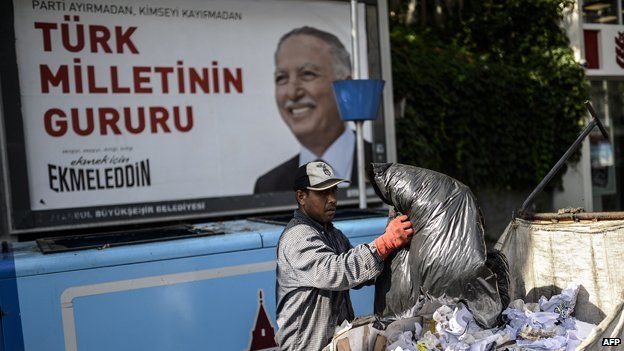
Above all, Mr Erdogan relies on one overarching claim: that he has the support of voters. Ever since his Justice and Development (AK) party was catapulted to power in November 2002, its electoral success has been impressive. AK’s share of the vote rose to 47% in 2007 and almost 50% in 2011 (though it fell below 40% in municipal elections in 2009). Mr Erdogan has adopted a fiercely majoritarian attitude: so long as voters back him, he is entitled to do whatever he wants, heedless of opponents, protesters, judges, prosecutors or Europe. In a country with weak institutions and few checks and balances, such a view inevitably tends to authoritarianism.
On March 30th the prime minister’s support among Turkish voters will be put to the test, for the first time since the Gezi protests and the corruption probe, in municipal elections. Mr Erdogan has explicitly turned these into a referendum on himself and his party. If AK does well, which most analysts reckon means winning over 40% of the vote and keeping control of both Ankara and Istanbul, Mr Erdogan will claim vindication for his tough policies.
The outcome is highly uncertain. The main opposition parties, the Republican People’s Party (CHP) and the Nationalist Action Party (MHP) are weak. AK remains very strong in its Anatolian heartland, which includes such cities as Bursa, Kayseri and Konya. But Mr Erdogan’s approval rating has fallen over the past year. The CHP is quietly confident of winning Ankara, and it even hopes to upset AK in Istanbul, the city where Mr Erdogan began his political career. If AK does that badly, one minister predicts, it might even split.
Besides his 11 years in office, Gezi and the corruption cases, another reason why some Turks are tiring of Mr Erdogan is the economy. During AK’s time in power, GDP per head has tripled in real terms. After a sharp drop in 2009, growth bounced back to China-like levels in 2010 and 2011 (see chart). But this year it may be barely above 3%. The IMF reckons trend growth has dropped from 7% to 3%, too low to stop unemployment rising. Turkey also has the biggest current-account deficit in the OECD rich-country club, making it vulnerable to a loss of foreign confidence. Not surprisingly the lira has tumbled, shedding some 24% of its value against the dollar since last April and pushing up inflation.
Mehmet Simsek, the finance minister, rejects warnings about the economy as alarmist. He says all emerging markets have suffered since America signalled that interest rates might start rising. The current account was hit by high gold imports. Worries about corporate exposure to foreign-currency debt are exaggerated: most is owed by the biggest exporters. For the long term, he talks of better infrastructure, education (he points to 400,000 extra teachers and 210,000 extra classrooms) and more investment in R&D. He notes that Turkey has climbed from 71st to 44th in the World Economic Forum’s competitiveness table.
Yet Turkey’s weaknesses are obvious. Female participation in the workforce is the lowest in the OECD. Inequality is alarmingly high. Turkey comes a lowly 69th in the World Bank’s “Doing Business” rankings. In many ways it is in a middle-income trap: the low-cost advantage that the Anatolian tigers had in textiles, furniture, white goods and carmaking has been eroded by rising wages (and prices), but productivity and skills are not good enough to switch easily to higher-value production.
Above all is the uncertainty about Turkey’s political direction. Although the new European Union minister, Mevlut Cavusoglu, talks of 2014 as the year of the EU, he concedes that popular support for EU membership has fallen from 70% in 2005 to only 40% today. In truth EU membership talks are stalled, and they are unlikely to revive soon, not least because Mr Erdogan has lost interest. He is also said to have become more dismissive of Turkey’s NATO membership. Losing the EU anchor, in particular, worries businessmen. Muharrem Yilmaz, chairman of Tusiad, the industrialists’ lobby, complains that the government did not take advantage of EU membership talks to strengthen political and economic institutions, and that its reform momentum has run out.
What might Mr Erdogan do next? He had hoped to stand for president in August, when the term of the incumbent, Abdullah Gul, a co-founder of AK, runs out. Mr Gul, who has avoided clashing directly with Mr Erdogan but made clear his unhappiness with his restrictive laws, could then become prime minister. But recent events have reduced the chances of Mr Erdogan stepping up to the presidency, not least because he has been unable to amend the constitution to give the job greater powers. So he may prefer to let Mr Gul run again and instead scrap the internal AK party rule against any MP running for a fourth term. That would let him stay on as prime minister and perhaps bring forward the general election due next year.
Yet such a move would only confirm criticism of Mr Erdogan’s autocratic ways. Some even draw analogies with Mr Putin’s desire for a fourth term as Russian president. Aykan Erdemir, a young CHP MP, says the situation makes him think of other embattled leaders in their bunkers, surrounded by yes-men. Put simply, the prime minister lacks an exit strategy. It would be better for his country if he found one.
What does it take to be a good parent? We know some of the tricks for teaching kids to become high achievers. For example, research suggests that when parents praise effort rather than ability, children develop a stronger work ethic and become more motivated.
Yet although some parents live vicariously through their children’s accomplishments, success is not the No. 1 priority for most parents. We’re much more concerned about our children becoming kind, compassionate and helpful. Surveys reveal that in the United States, parents from European, Asian, Hispanic and African ethnic groups all place far greater importance on caring than achievement. These patterns hold around the world: When people in 50 countries were asked to report their guiding principles in life, the value that mattered most was not achievement, but caring.
Despite the significance that it holds in our lives, teaching children to care about others is no simple task. In an Israeli study of nearly 600 families, parents who valued kindness and compassion frequently failed to raise children who shared those values.
Are some children simply good-natured – or not? For the past decade, I’ve been studying the surprising success of people who frequently help others without any strings attached. As the father of two daughters and a son, I’ve become increasingly curious about how these generous tendencies develop.
Genetic twin studies suggest that anywhere from a quarter to more than half of our propensity to be giving and caring is inherited. That leaves a lot of room for nurture, and the evidence on how parents raise kind and compassionate children flies in the face of what many of even the most well-intentioned parents do in praising good behavior, responding to bad behavior, and communicating their values.
By age 2, children experience some moral emotions – feelings triggered by right and wrong. To reinforce caring as the right behavior, research indicates, praise is more effective than rewards. Rewards run the risk of leading children to be kind only when a carrot is offered, whereas praise communicates that sharing is intrinsically worthwhile for its own sake. But what kind of praise should we give when our children show early signs of generosity?
Many parents believe it’s important to compliment the behavior, not the child – that way, the child learns to repeat the behavior. Indeed, I know one couple who are careful to say, “That was such a helpful thing to do,” instead of, “You’re a helpful person.”
But is that the right approach? In a clever experiment, the researchers Joan E. Grusec and Erica Redler set out to investigate what happens when we commend generous behavior versus generous character. After 7- and 8-year-olds won marbles and donated some to poor children, the experimenter remarked, “Gee, you shared quite a bit.”
The researchers randomly assigned the children to receive different types of praise. For some of the children, they praised the action: “It was good that you gave some of your marbles to those poor children. Yes, that was a nice and helpful thing to do.” For others, they praised the character behind the action: “I guess you’re the kind of person who likes to help others whenever you can. Yes, you are a very nice and helpful person.”
A couple of weeks later, when faced with more opportunities to give and share, the children were much more generous after their character had been praised than after their actions had been. Praising their character helped them internalize it as part of their identities. The children learned who they were from observing their own actions: I am a helpful person. This dovetails with new research led by the psychologist Christopher J. Bryan, who finds that for moral behaviors, nouns work better than verbs. To get 3- to 6-year-olds to help with a task, rather than inviting them “to help,” it was 22 to 29 percent more effective to encourage them to “be a helper.” Cheating was cut in half when instead of, “Please don’t cheat,” participants were told, “Please don’t be a cheater.” When our actions become a reflection of our character, we lean more heavily toward the moral and generous choices. Over time it can become part of us.
Praise appears to be particularly influential in the critical periods when children develop a stronger sense of identity. When the researchers Joan E. Grusec and Erica Redler praised the character of 5-year-olds, any benefits that may have emerged didn’t have a lasting impact: They may have been too young to internalize moral character as part of a stable sense of self. And by the time children turned 10, the differences between praising character and praising actions vanished: Both were effective. Tying generosity to character appears to matter most around age 8, when children may be starting to crystallize notions of identity.
Praise in response to good behavior may be half the battle, but our responses to bad behavior have consequences, too. When children cause harm, they typically feel one of two moral emotions: shame or guilt. Despite the common belief that these emotions are interchangeable, research led by the psychologist June Price Tangney reveals that they have very different causes and consequences.
Shame is the feeling that I am a bad person, whereas guilt is the feeling that I have done a bad thing. Shame is a negative judgment about the core self, which is devastating: Shame makes children feel small and worthless, and they respond either by lashing out at the target or escaping the situation altogether. In contrast, guilt is a negative judgment about an action, which can be repaired by good behavior. When children feel guilt, they tend to experience remorse and regret, empathize with the person they have harmed, and aim to make it right.
In one study spearheaded by the psychologist Karen Caplovitz Barrett, parents rated their toddlers’ tendencies to experience shame and guilt at home. The toddlers received a rag doll, and the leg fell off while they were playing with it alone. The shame-prone toddlers avoided the researcher and did not volunteer that they broke the doll. The guilt-prone toddlers were more likely to fix the doll, approach the experimenter, and explain what happened. The ashamed toddlers were avoiders; the guilty toddlers were amenders.
If we want our children to care about others, we need to teach them to feel guilt rather than shame when they misbehave. In a review of research on emotions and moral development, the psychologist Nancy Eisenberg suggests that shame emerges when parents express anger, withdraw their love, or try to assert their power through threats of punishment: Children may begin to believe that they are bad people. Fearing this effect, some parents fail to exercise discipline at all, which can hinder the development of strong moral standards.
The most effective response to bad behavior is to express disappointment. According to independent reviews by Professor Eisenberg and David R. Shaffer, parents raise caring children by expressing disappointment and explaining why the behavior was wrong, how it affected others, and how they can rectify the situation. This enables children to develop standards for judging their actions, feelings of empathy and responsibility for others, and a sense of moral identity, which are conducive to becoming a helpful person. The beauty of expressing disappointment is that it communicates disapproval of the bad behavior, coupled with high expectations and the potential for improvement: “You’re a good person, even if you did a bad thing, and I know you can do better.”
As powerful as it is to criticize bad behavior and praise good character, raising a generous child involves more than waiting for opportunities to react to the actions of our children. As parents, we want to be proactive in communicating our values to our children. Yet many of us do this the wrong way.
In a classic experiment, the psychologist J. Philippe Rushton gave 140 elementary- and middle-school-age children tokens for winning a game, which they could keep entirely or donate some to a child in poverty. They first watched a teacher figure play the game either selfishly or generously, and then preach to them the value of taking, giving or neither. The adult’s influence was significant: Actions spoke louder than words. When the adult behaved selfishly, children followed suit. The words didn’t make much difference – children gave fewer tokens after observing the adult’s selfish actions, regardless of whether the adult verbally advocated selfishness or generosity. When the adult acted generously, students gave the same amount whether generosity was preached or not – they donated 85 percent more than the norm in both cases. When the adult preached selfishness, even after the adult acted generously, the students still gave 49 percent more than the norm. Children learn generosity not by listening to what their role models say, but by observing what they do.
To test whether these role-modeling effects persisted over time, two months later researchers observed the children playing the game again. Would the modeling or the preaching influence whether the children gave – and would they even remember it from two months earlier?
The most generous children were those who watched the teacher give but not say anything. Two months later, these children were 31 percent more generous than those who observed the same behavior but also heard it preached. The message from this research is loud and clear: If you don’t model generosity, preaching it may not help in the short run, and in the long run, preaching is less effective than giving while saying nothing at all.
People often believe that character causes action, but when it comes to producing moral children, we need to remember that action also shapes character. As the psychologist Karl Weick is fond of asking, “How can I know who I am until I see what I do? How can I know what I value until I see where I walk?”
Adam Grant is a professor of management and psychology at the Wharton School of the University of Pennsylvania and the author of “Give and Take: Why Helping Others Drives Our Success.”
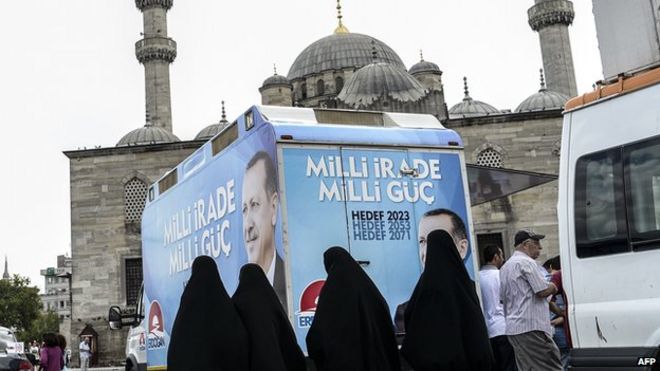
In Turkey all eyes are on outgoing Prime Minister Recep Tayyip Erdogan, who is bidding to become president in Sunday’s election.
Is Mr Erdogan set to become as omnipotent as Russia’s Vladimir Putin? The last time I stood in Istanbul’s majestic Taksim Square was the evening of 11 June last year. I had watched all afternoon as tens of thousands of protesters meandered through – stopping for a “cay” in a tulip-shaped glass teacup – and an exquisitely barbequed fish kebab from one of the many stalls which had sprung up out of nowhere since these protests had begun the week before.
They were here because the week before the Turkish state had tear-gassed a makeshift camp of peaceful, eco-friendly, idealistic hippy student types in Gezi Park next door.
They’d been protesting against the chopping down of some of the last trees in central Istanbul to make way for a five-star redevelopment way out of the reach of most Istanbulians. The development plan – and the government’s reaction to peaceful protest – had stirred middle-aged, urban and secular residents of this city out of their slumber and into Taksim Square in solidarity with the young.
They were also demonstrating against what they saw as the increasingly hectoring and moralistic religious style of the Prime Minister, Recep Tayyip Erdogan. Their protest was met by water-cannon and tear-gas as the police turned on everyone present – young and old – without warning. Many here insist that what happened that night, and on several others after, was a scandal by European standards of liberal democracy and should have foretold the end of Erdogan’s career at home and abroad.
But no, Teflon Tayyip, as he is known in more irreverent Turkish circles, is still a force to be reckoned with and on Sunday he will make a bid to be the democratically elected president of Turkey.
It is widely expected that he’ll succeed in taking his prime ministerial powers with him from parliament to the presidential palace – Putin-style. Not even the recent corruption allegations made by his former political allies, his habit of locking up anyone who disagrees with him, nor the government’s inadequate reaction to the Soma mining disaster in May, in which 301 miners died, have seriously dented his chances.
Likewise abroad, diplomats roll their eyes in frustration at any mention of his name. But any inclination of politicians to publically criticise Teflon Tayyip is quashed when their advisers point out Turkey’s crucial diplomatic role in the region. Not just in dealing with Syrian refugees but also in coping with the jihadists of the Islamic State in northern Iraq.
This means Mr Erdogan is not overly troubled by what his friends in London, Brussels or Washington say about him on or off the record. What he is intent on now is remaining in power until the centenary of the Turkish republic in 2023.
And he will probably succeed because, while Turkey is not a liberal democracy, it is still a democracy, and enough people will vote for him.
Many Turks like the new roads, metro lines, high-speed rail links and shiny hotels which have sprung up across Istanbul, and the whole of Turkey, providing a boost for the economy. The AKP has also improved social welfare and health care provision for ordinary working class Turks.
The harsh reality is that a significant proportion of people in Turkey don’t give two hoots about the liberal secular elite and their over-educated, idealistic, eco-friendly offspring. “They had their turn and now it’s ours,” said a man playing backgammon in a tea shop on a narrow sloping street in the less trendy Tarlabasi district on the other side of Taksim Square. And so Mr Erdogan can continue to accumulate power and influence because enough of the electorate don’t care about the AKP’s cronyism, control of the media, alleged corruption or even the suggestion by the deputy prime minister that women shouldn’t laugh in public. It seems those who oppose the AKP know they are beaten – for now.
It is such a foregone conclusion that the prime minister will now become the president that protests – and the prospect of another tear-gassing – are just not worth the bother. Hardcore activists remain, of course, but most Turks, even those bitterly opposed to Mr Erdogan, would rather stay at home and watch the telly with their feet up. And perhaps you can’t blame them – it’s not pleasant being tear-gassed after all.
Every year, I try to do at least two things with my students at least once. First, I make a point of addressing them as “philosophers” – a bit cheesy, but hopefully it encourages active learning. Secondly, I say something like this: “I’m sure you’ve heard the expression ‘everyone is entitled to their opinion.’ Perhaps you’ve even said it yourself, maybe to head off an argument or bring one to a close. Well, as soon as you walk into this room, it’s no longer true. You are not entitled to your opinion. You are only entitled to what you can argue for.”
A bit harsh? Perhaps, but philosophy teachers owe it to our students to teach them how to construct and defend an argument – and to recognize when a belief has become indefensible.
The problem with “I’m entitled to my opinion” is that, all too often, it’s used to shelter beliefs that should have been abandoned. It becomes shorthand for “I can say or think whatever I like” – and by extension, continuing to argue is somehow disrespectful. And this attitude feeds, I suggest, into the false equivalence between experts and non-experts that is an increasingly pernicious feature of our public discourse.
Firstly, what’s an opinion? Plato distinguished between opinion or common belief (doxa) and certain knowledge, and that’s still a workable distinction today: unlike “1+1=2” or “there are no square circles,” an opinion has a degree of subjectivity and uncertainty to it. But “opinion” ranges from tastes or preferences, through views about questions that concern most people such as prudence or politics, to views grounded in technical expertise, such as legal or scientific opinions.
You can’t really argue about the first kind of opinion. I’d be silly to insist that you’re wrong to think strawberry ice cream is better than chocolate. The problem is that sometimes we implicitly seem to take opinions of the second and even the third sort to be unarguable in the way questions of taste are. Perhaps that’s one reason (no doubt there are others) why enthusiastic amateurs think they’re entitled to disagree with climate scientists and immunologists and have their views “respected.”
Meryl Dorey is the leader of the Australian Vaccination Network, which despite the name is vehemently anti-vaccine. Ms. Dorey has no medical qualifications, but argues that if Bob Brown is allowed to comment on nuclear power despite not being a scientist, she should be allowed to comment on vaccines. But no-one assumes Dr. Brown is an authority on the physics of nuclear fission; his job is to comment on the policy responses to the science, not the science itself.
So what does it mean to be “entitled” to an opinion? If “Everyone’s entitled to their opinion” just means no-one has the right to stop people thinking and saying whatever they want, then the statement is true, but fairly trivial. No one can stop you saying that vaccines cause autism, no matter how many times that claim has been disproven.
But if ‘entitled to an opinion’ means ‘entitled to have your views treated as serious candidates for the truth’ then it’s pretty clearly false. And this too is a distinction that tends to get blurred. On Monday, the ABC’s Mediawatch program took WIN-TV Wollongong to task for running a story on a measles outbreak which included comment from – you guessed it – Meryl Dorey. In a response to a viewer complaint, WIN said that the story was “accurate, fair and balanced and presented the views of the medical practitioners and of the choice groups.”
But this implies an equal right to be heard on a matter in which only one of the two parties has the relevant expertise. Again, if this was about policy responses to science, this would be reasonable. But the so-called “debate” here is about the science itself, and the “choice groups” simply don’t have a claim on air time if that’s where the disagreement is supposed to lie.
Mediawatch host Jonathan Holmes was considerably more blunt: “there’s evidence, and there’s bulldust,” and it’s not part of a reporter’s job to give bulldust equal time with serious expertise. The response from anti-vaccination voices was predictable. On the Mediawatch site, Ms. Dorey accused the ABC of “openly calling for censorship of a scientific debate.” This response confuses not having your views taken seriously with not being allowed to hold or express those views at all – or to borrow a phrase from Andrew Brown, it “confuses losing an argument with losing the right to argue.” Again, two senses of “entitlement” to an opinion are being conflated here.
So next time you hear someone declare they’re entitled to their opinion, ask them why they think that. Chances are, if nothing else, you’ll end up having a more enjoyable conversation that way.
Kids don’t have the cognitive skills to truly understand the concept of empathy until they’re 8 or 9. But 5-year-olds, usually highly preoccupied with fairness, are concerned about being treated well, and they want others – friends, strangers, even characters in books – to be treated well too. Here’s how to nurture these budding displays of empathy.
What you can do
Label the feeling. Your kindergartner will be able to understand and manage her emotions much better if she can recognize her feelings. So put a name to her behavior as often as you can. Say, for instance, “It was very kind of you to talk to that boy who was all alone on the swing. He might have been feeling lonely.” By hearing that you noticed her behavior, she’ll learn that you recognize and value her responsiveness.
She needs to understand negative emotions, too, so don’t be afraid to calmly point out when your 5-year-old’s being less than caring. Try saying, “It made your baby brother really sad when you grabbed his rattle. What could you do to help him feel better?”
Another way to teach your kindergartner to understand and define her emotions is to have a “feeling of the week.” Each week, put up on the refrigerator or bulletin board a picture of someone experiencing a basic emotion – sadness, happiness, surprise, anger. Work your way up to more complicated emotions, such as frustration, nervousness, and jealousy (clip magazine photos or illustrations that capture these feelings). Talk with your child about times when she felt the same way.
Praise empathetic behavior. When your kindergartner performs an act of kindness, tell her what she did right, and be as specific as possible: “You were very generous to share your special stickers with Tommy. I saw him smiling, and I know he was happy.”
Encourage your kindergartner to talk about her feelings – and yours. Let her know that you care about how she feels by listening intently. If she has a story about someone else (“Tommy got in trouble for shoving Therese, and I don’t think that was fair”), listen to her views before offering your own. And when she says she’s mad, paraphrase what she says – “Oh, you’re feeling grumpy today?” – so she knows you’re listening and feels encouraged to elaborate. Similarly, share your own feelings with her: “It makes me feel bad when you yell at me. Let’s think of another way for you to tell me you’re angry.”
This is also a fine time to share some of your feelings that don’t relate to your child’s actions. You can say, “I’m frustrated that I didn’t meet my deadline at work today” or “I got annoyed with Aunt Mary today, just like you get mad at your sister. But we’re still friends.”
Your 5-year-old will learn that adults have feelings and emotions too, that they’re a normal part of life, and that learning to cope with them is an important part of growing up.
Point out other people’s behavior. Teach your kindergartner to notice when someone else has behaved kindly. You might say, for example, “Remember how friendly your new teacher was on the first day of school? She helped you feel less scared.” By doing this, you reinforce her understanding of how people’s actions can affect her emotionally. Books also provide wonderful opportunities to explore emotions. Ask your 5-year-old how she thinks the children in a fairy tale are feeling, and whether she thinks she’d be scared or brave in the same situation. Tell her how you might feel too.
Teach nonverbal cues. At the playground or park, find a quiet place where you and your 5-year-old can sit and observe others without being rude. Play a game of guessing what other people are feeling, and explain the specific reasons for your own guesses: “See that man? He’s walking really quickly and his shoulders are hunched, and he’s making a mean face. I think he’s angry about something.”
Teach basic rules of politeness. Good manners are a great way for your kindergartner to show caring and respect for others. “Please” and “thank you” are phrases 5-year-olds should use automatically. Explain that you’re more inclined to hand over her sandwich when she asks for it politely and that you don’t like it when she orders you around. Even if these phrases sound rote at times, they teach kids how important it is to treat others with respect. Of course, being polite to her is worth a thousand rules and explanations. Say “please” and “thank you” regularly to your kindergartner and to others, and she’ll learn that these phrases are part of normal communication, both at home and out in public.
Don’t use anger to control your child. Though it’s easy to get upset when she sneaks the candy you told her not to eat before dinner, try not to use anger as a tool to manage her behavior. “When you say, ‘I’m really mad at you,’ children shut down and withdraw,” says Jerry L. Wyckoff, a psychologist and coauthor of Twenty Teachable Virtues. Teaching by instruction and example is much more effective, although it’s important to let your child know you’re disappointed. Instead of getting angry, take a moment to calm yourself down. Then say firmly, “I know you wanted that candy, but it upsets me that you ignored what I told you. Now you won’t be allowed to have dessert tonight.”
Give your kindergartner jobs. Research suggests that children who learn responsibility also learn altruism and caring. Five-year-olds can take over simple jobs, such as feeding the dog or clearing the dinner table. Don’t forget to pile on the praise for a job well done and point out that your child’s actions benefit everyone: “Thanks for remembering to set the table. We’re all really hungry, and you’ve helped us sit down to dinner a lot faster.”
Ask her to think of others. Each day is full of opportunities to remind your 5-year-old to think about how someone else might feel. “It’s simple – say you’re in the grocery store and your child asks for some licorice. Say, ‘Sure. Now, do you think your little sister would like us to bring home a treat for her?'” suggests Wayne Dosick, a rabbi and the author of Golden Rules: The Ten Ethical Values Parents Need to Teach Their Children.
Pay attention to your child’s social life. Asking specific questions about people in her daily life reinforces the importance of social relationships and treating people well. Questions such as “Who did you play with at recess today?” and “What did you talk to Tommy about on the bus?” can lead to discussions about treating others with respect and kindness.
Involve your kindergartner in charitable activities. Acts of kindness and charity are an excellent way to teach her empathy. When you take a meal to a sick neighbor or a friend with a new baby, let her help plan the menu. She can pack a bag of clothes to donate to a local charity and choose some of the toys she’s outgrown to give as well. Help her write a thank-you letter to Grandma for a birthday present. Explain that sometimes people need extra help, don’t have the basics that they need, or would just feel happy to receive a sign of appreciation.
Expect the same behavior from boys and girls. Our society commonly considers men to be less empathetic than women. So sometimes, even without realizing it, we demand and praise empathetic behavior less often in boys than in girls.
As Wyckoff says, “We set up this ‘boy code’ that goes on and on throughout their lives – ‘I gotta be tough.’ But if we’re careful to teach them, boys can learn empathy just like girls.”
With the result of Sunday’s referendum on its constitution, Turkey as we know it is over; it is history. The architecture of its governance designed by Mustafa Kemal Atatürk – Turkey’s founder – has, after a wobbly series of experiments with the military and a secular elite in charge, been dismantled by the leader of the Justice and Development party (AKP). The collapse of the rule of law that took place in slow motion after the Gezi Park protests has been followed by the erosion of the separation of powers and the annihilation of the independent media. It’s hard not to notice the striking resemblance to the sequence of events in Germany from 1933: the Reichstag fire, the Night of the Long Knives, the infamous referendum in 1934. The similarities give one a powerful sense of history copy-and-pasting itself. No wonder those who once shrugged at such comparisons are now in shock – particularly when they heard the harsh rhetoric of President Erdoğan‘s victory speech: he pledged to an ecstatic crowd that one of his highest priorities is to reintroduce capital punishment. This is one possible interpretation. Another is that Sunday’s result was the closing of a chapter in which the “periphery” of Turkish society – rural and mainly pious – took its revenge on the “centre” of the old republic. That is what some figures of the AKP have called “the silent revolution”. “The Turkish republic has an undeniably complicated history,” wrote Steven Cook, from the Council on Foreign Relations, in an essay for Foreign Policy, entitled RIP Turkey; 1921-2017. “It is an enormous achievement. In the space of almost a century, a largely agrarian society that had been devastated by war was transformed into a prosperous power that wielded influence in its own region and well beyond. At the same time, modern Turkey’s history has also been nondemocratic, repressive and sometimes violent. It thus makes perfect political sense for Erdoğan to seek the transformation of Turkey by empowering the presidency and thereby closing off the possibility once and for all that people like him will be victims of the republic.” It has been painful for me to witness the immense disappointment of Turkish intellectuals, resilient by tradition, and mainly left-leaning. All I could hear by phone or on social media was tormented despair – a crushing sense of defeat. What united all those in academia and the media or in NGOs, regardless of their political stripes, was that they had hoped for democratic change under the AKP. Many of them had given credit to the party, and its early pledges and steps towards an order where the sharing of power would break the vicious circle of the republic. They wanted to believe in human rights, freedom and an end to the decades-long Kurdish conflict. But the deliberate reversal of democratisation left all of them feeling they had been duped. This conclusion became undeniable when last summer’s attempted coup – the details of which are still unclear – led to an immense purge. Given this mood of despair and the sense of defeat, we should expect another exodus of fine human resources in the coming months and years. Journalists – such as me, abroad, or at home – will find themselves challenged even more after the referendum. Coverage of corruption will be a daredevil act, severe measures against critical journalism will continue and the remaining resistance of media proprietors will vanish. The Turkish media will begin to resemble those of the Central Asian republics, where only mouthpieces for those in power are allowed to exist. Inevitably, these conditions will shift the epicentre of independent journalism to outside the borders of Turkey. My colleagues have already realised that their dreams of a dignified fourth estate were nothing but an illusion. “At the end of the day, Erdoğan is simply replacing one form of authoritarianism with another,” wrote Cook. “The Turkish republic has always been flawed, but it always contained the aspiration that – against the backdrop of the principles to which successive constitutions claimed fidelity – it could become a democracy. Erdoğan’s new Turkey closes off that prospect.” The old republic was already ailing, and it has just been dealt its final blow.
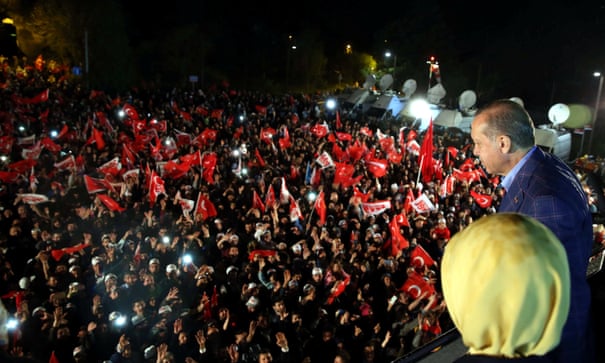
IT WAS a vote that turned out to be as controversial as it was hotly contested. Even before all of the ballots had been counted, Recep Tayyip Erdogan, Turkey’s president, stepped in front of a crowd of supporters in Istanbul and proclaimed victory. “My nation stood upright and undivided,” he said, referring to the referendum on a constitution that will give him new, virtually unchecked powers. “April 16th was a victory for all of Turkey.” Yet it was hardly the win Mr Erdogan had expected. The Yes camp, which the president headed, limped away with just 51.4% of the vote. The opposition accused the country’s electoral authority of foul play. Outside observers charged the government with stacking the odds in its favour. Anti-government demonstrations broke out in a number of Turkish cities. The country awoke the following morning more divided than ever. The new constitution will bring about the most radical overhaul of the state since 1923, when it went from being an imperial Islamic power to a secular republic under Kemal Ataturk, the founder of modern Turkey. After fresh elections in 2019, Mr Erdogan will rule uncontested, appointing senior officials, judges and members of his own cabinet, with little oversight by an expanded but weakened parliament. The office of prime minister will cease to exist. Yet the constitution is already mired in controversy. The main opposition, the secular Republican People’s party (CHP), has asked for the referendum results to be annulled. A last-minute decision by the country’s electoral board to accept unstamped ballot papers created the risk of mass fraud, the CHP said. Claims of vote-rigging, especially in the Kurdish southeast, have been pouring in. In a scathing assessment, observers from the Organisation for Security and Co-operation in Europe (OSCE), an intergovernmental body, said the board’s move had “undermined an important safeguard and contradicted the law”. A state of emergency imposed shortly after an attempted coup in July, accompanied by nearly 50,000 arrests and a climate of intimidation and nationalist hysteria, was hardly the proper setting for a referendum on systemic changes. “Voters were not provided with impartial information about key aspects of the reform and limitations on fundamental freedoms had a negative effect,” the OSCE said. There is next to no chance of a recount. The electoral board rejected the opposition’s appeal on April 19th, but promised to look into individual allegations of fraud. (Official results are expected towards the end of April.) Mr Erdogan asked foreign observers to keep their concerns to themselves. “We don’t care about the opinions of ‘Hans’ or ‘George’,” he said. His prime minister added: “The people’s decision is clear and the result is a Yes.” The allegations will haunt Mr Erdogan for years, leaving the country even more polarised than before. Mr Erdogan might be “the most unassailable Turkish leader since Ataturk but this legitimacy issue will hang over his head,” says Soner Cagaptay, a fellow at the Washington Institute. International reaction has been muted. Other than Donald Trump’s America, which joined model democracies such as Russia, Sudan, Hungary and Djibouti in congratulating Mr Erdogan, no leader of a big Western country has welcomed the vote. Britain, Germany and the EU called instead for dialogue and an impartial inquiry. Mr Erdogan did not appear particularly keen to rebuild bridges with Europe: on the day of the vote, he pledged once again to do his part to reinstate the death penalty, which would threaten the membership of Turkey in the Council of Europe and torpedo its already comatose accession talks with the EU.
One man show
Supporters of the new constitution say it will improve decision-making by concentrating power in Mr Erdogan’s hands, precluding unwieldy political coalitions and neutralising powerful unelected officials. “From now on, it’s the people who are going to rule Turkey,” says Ufuk, a young Yes voter relaxing outside a polling booth. Opponents say it will transform the government, already dominated by Mr Erdogan, into an authoritarian regime. “This is the beginning of one-man rule,” says Ali Bayramoglu, a columnist who used to be sympathetic to the ruling Justice and Development (AK) party. After he said earlier this month that he would oppose the new constitution, Mr Bayramoglu was assaulted by AK supporters at a polling station on the day of the vote. Some of the changes will come into effect immediately. An impartiality clause that required the president to sever links with any political party (which he flouted) will expire. Mr Erdogan is expected formally to rejoin AK as soon as official results are announced this week. Within a month, the country’s most influential judicial body, the council of judges and prosecutors, will shrink and move from a system of election by peers to one of appointment by parliament and the president. Mr Erdogan’s initial comments suggest he will disregard the slim margin of victory and portray the referendum as a sign of support for his crackdown. The day after the vote, his government extended the state of emergency until July 19th. Two days after that, police arrested some 38 people accused of participating in protests. Turkey is saddled with a constitution opposed by nearly half of all voters in a referendum tainted by fraud claims and held under conditions that made open debate impossible. Mr Erdogan has the powers he has long coveted. They come at the cost of tension at home and isolation abroad. This article appeared in the Europe section of the print edition under the headline “Erdogan the maleficent”


 90 percent of Turkish corporate debt is denominated in foreign currencies, which dangerously exposes the country’s corporate borrowers to weakness in the Turkish lira currency, which is down by over 18 percent against the U.S. dollar in the past year:
  Even more worrisome is the fact that U.S.
  Turkey’s current account deficit to GDP ratio has swelled to over 6 percent – a level that has led to currency crises in the past:
  Turkey’s Consumption Boom Is Actually A Bubble Accounting for
  Turkish consumers have focused much of their discretionary spending on goods such as automobiles, consumer electronics, and household appliances. Numerous foreign multinational corporations have
  Source:
  Turkey’s ballooning mortgage bubble – which expanded by 28 percent last year alone – helped to finance a
  Turkey’s construction boom has been rife with corruption and scandals involving allies of Prime Minister Recep Tayyip Erdoğan. On December 17th 2013, news of a 15-month secret investigation broke that led to the arrest or questioning of
  Source:
  Booming stock and property prices have led to a surge in the number of wealthy Turks since 2002, including a
  Turkey’s latest turmoil led to its categorization as one of the “Fragile Five” emerging economies, which also includes South Africa, Brazil, Indonesia, and India. The Fragile Five experienced the most pain among emerging markets since the spring 2013 because of their large current account and trade deficits, high inflation, significant dependence on foreign capital inflows, and slowing economic growth. To shore up Turkey’s currency after its sharp decline, Prime Minister Erdoğan was finally forced to give in to the demands of a group of Turkish leaders that he called the “interest rate lobby” that he had long battled against due to their calls for higher interest rates. On January 28th 2014, Turkish Central Bank Governor Erdem Basci – a member of the so-called “interest rate lobby” – surprised the world when he ordered dramatic hikes of the overnight lending rate from 7.75 to 12.5 percent, the overnight borrowing rate from 3.5 percent to 8 percent, and the benchmark one-week repurchase rate from 4.5 percent to 10 percent:
 The World Is Still Unaware Of Turkey’s Economic Bubble Though Turkish and international financial markets initially cheered January’s surprise rate hikes, I view this as evidence that the world is still unaware that Turkey’s economic boom is actually a credit-driven bubble that is predicated on ultra-low interest rates, both foreign and domestic. Falling interest rates helped to inflate Turkey’s bubble economy, and rising interest rates will put an end to it. This is a very simple concept, yet so few people understand it – even after the events of 2008. I see even more evidence that the world is largely unaware of Turkey’s economic bubble in the fact that the vast majority of the recent discourse about Turkey’s problems is myopically focused on the country’s current account deficit and currency weakness, while virtually ignoring the risks posed by the eventual popping of Turkey’s credit bubble. I believe that this myopia is caused by denial of the existence of Turkey’s economic bubble in the first place, along with a mental block that is causing economists and commentators to focus too much on a 1997-style currency crisis, as if that is the only possible template for emerging market crises to follow. It is important to remember that history doesn’t repeat itself, but it does rhyme. The popping of the overall emerging markets bubble will cause a very severe global economic crisis, but it is wrong to expect this crisis to play out identically to the 1997 Asian financial crisis. Like snowflakes, no two economic crises are the same. Contrary to popular belief, Turkey’s currency weakness is not a new phenomenon, as it has been a consistent trend for the last six years:
  Despite the Turkish lira’s downtrend of the past six years, Turkey’s credit and asset bubble has continued to inflate to dizzying new heights, as it has also done since the spring 2013 panic. I am certainly not denying the risks posed by the Turkish lira’s rout, but I do not believe that Turkey’s economic bubble has truly popped yet. The lira’s weakness is the precursor to Turkey’s coming economic bust, but it is not “The Crisis” in and of itself. Lack of awareness and understanding of the implications of Turkey’s credit-driven bubble economy is the reason why most mainstream economists and commentators are still relatively optimistic on the country’s long-term economic prospects, even if they concede that growth will slow. Unfortunately, credit bubbles of the magnitude of Turkey’s do not end in a mere economic slowdown, but in a crisis. How Turkey’s Economic Bubble Will Pop Turkey’s economic bubble is likely to pop as a result of rising short and long-term interest rates, and may coincide with the popping of the overall emerging markets bubble. As the U.S. Federal Reserve follows through with its QE taper – which is expected to be completed this year – the flow of “hot money” to emerging markets will reverse, which will cause those countries’ currencies to decline and bond yields to climb. Turkey’s $129.1 billion short-term external debt that will come due over the next year is an additional related catalyst that will likely contribute to the popping of the country’s bubble. Here is what to expect when Turkey’s economic bubble truly pops: