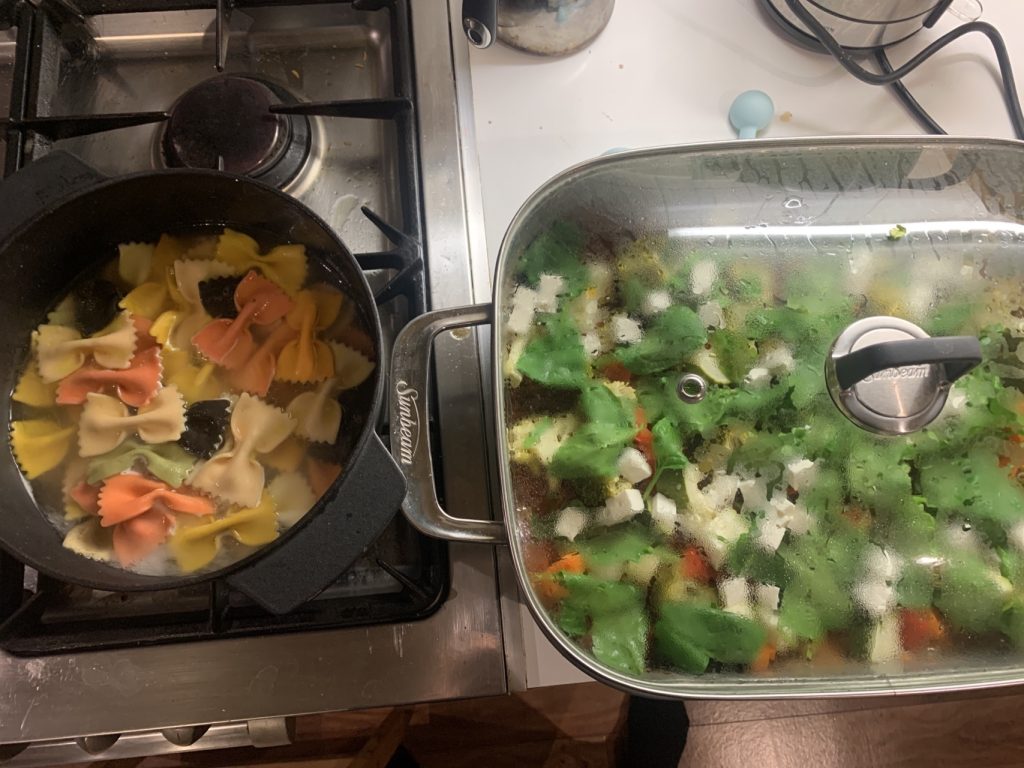
Heat frypan on setting 15. Add potatoes and cover with water. Cover with the lid. Simmer until potatoes are tender. Drain.
Heat frypan on setting 12. Add potatoes, oil, and mustard seeds. Season to taste with salt and pepper. Cook for 15 minutes or until potatoes are golden. Serve.
Heat oil in the frypan on setting 12. Add onion and cook for 2-3 minutes or until tender. Set aside.
In a large bowl combine onion, breadcrumbs, butter, thyme, parsley, lemon. Season with salt and pepper. Place mixture inside the cavity of the chicken. Tie wings together with kitchen twine.
Preheat frypan to setting 10. Place chicken in the pan. Cook for 1-2 minutes on each side or until golden. Cover with the lide. Reduce heat to setting 8. Cook for 1-1.5 hours or until cooked. Season to taste with salt and pepper.
The ocean circulation in the north Atlantic is likely to collapse sooner than expected as a result of climate change, causing further upheaval in weather patterns around the globe, new peer-reviewed scientific analysis finds.
The latest study of the currents or “conveyor belt” that carry warmer water upwards from the tropics concludes the Atlantic Meridional Overturning Circulation (Amoc) will shut down at some point between 2025 and 2095, with the 2050s most likely.
The University of Copenhagen researchers predicted the outcome with 95 per cent confidence in the paper published in the journal Nature Communications.
The findings by Copenhagen professors Peter Ditlevsen and Susanne Ditlevsen contrast with the view of the UN Intergovernmental Panel on Climate Change that Amoc is unlikely to collapse this century, and some scientists remain wary of departing from the IPCC’s predictions.
A collapse of Amoc, which includes the Gulf Stream stretching from Florida to north-western Europe, would produce pronounced cooling across the northern hemisphere, leading to stormier winters and drier summers in Europe.
Conversely, heat would intensify further south, as less warmth is transferred to temperate and polar latitudes, and there would be large changes in tropical rainfall and monsoons.
It is one of the most feared of the “tipping points” for the planet, or irreversible changes, that are threatened by global warming.
“I was surprised we found that the tipping point would come so soon and that we could constrain its timing so strongly to the next 70 years,” said Peter Ditlevsen. He said the IPCC models were “too conservative” and did not take into account early warning signals of instability reported more recently.
Stefan Rahmstorf, professor of ocean physics at Potsdam University and one of Europe’s leading climate scientists, said the growing body of science around the world’s ocean current systems showed a marked shift.
“The findings are in line with a couple of other studies in recent years suggesting that the Amoc tipping point is perhaps much closer than we previously thought. The evidence is mounting and is in my view alarming.”
Tim Lenton, one of the world’s foremost experts on tipping points and professor of climate science at Exeter university, noted the study had “made important improvements to the methods of providing early warning of a climate tipping point directly from data”.
“Once past the tipping point, the collapse of the Amoc would be irreversible,” Lenton said. “The collapse and its impacts will take time to unfold, but how long is uncertain,” he added.
Other climate scientists were more doubtful about the data and analytical methods used by the Copenhagen researchers.
“It is an interesting paper and emphasises Amoc collapse as a reason for concern,” said Richard Wood, head of the climate and oceans group at the UK Met Office Hadley Centre. “But I’m not abandoning the IPCC view, expressed with medium confidence, that it won’t collapse this century, though we do expect a weakening of the Amoc.”
Geological evidence suggests that during the last ice ages drastic changes in Atlantic circulation took place within a decade or two, but some climate models predict that it might take a century or so for the Amoc to halt completely under 21st-century circumstances. Even a partial shutdown would exacerbate the disruption caused by global warming.
Other worrying manifestations of global warming in the oceans include exceptionally high sea surface temperatures now being recorded around temperate regions of the northern hemisphere — as much as 5C above average off the east coast of Canada — while sea ice around Antarctica is at an all-time winter low. These are not directly related to changes in the Amoc.
The Ditlevsens — a brother and sister research partnership — said their results added to the urgency of global action to cut greenhouse gases. But Susanne Ditlevsen was not optimistic about the chances of avoiding an Amoc collapse.
“From what I see in the data it doesn’t look as though we can reverse it, unless there is a huge change in political views everywhere in the world, including China and the United States,” she said.
2 to 3 medium (20 cm), very ripe bananas peeled (about 1 1/4 to 1 1/2 cups mashed)
75g butter, unsalted or salted, melted
1/2 teaspoon baking soda (not baking powder)
1 pinch salt
3/4 cup (150g) sugar (1/2 cup if you would like it less sweet, 1 cup if more sweet)
1 large egg, beaten
1 teaspoon vanilla extract
1 1/2 cups (200g) all-purpose flour
Method
Preheat the oven and prepare the pan:Preheat the oven to 175°C, and butter an 20cm x 10cm loaf pan.
Mash the bananas and add the butter:In a mixing bowl, mash the ripe bananas with a fork until completely smooth. Stir the melted butter into the mashed bananas.
Mix in the remaining ingredients:Mix in the baking soda and salt. Stir in the sugar, beaten egg, and vanilla extract. Mix in the flour.
Bake the bread:Pour the batter into your prepared loaf pan.
Bake for 55 to 65 minutes at 175°C, or until a toothpick or wooden skewer inserted into the center comes out clean. A few dry crumbs are okay; streaks of wet batter are not. If the outside of the loaf is browned but the center is still wet, loosely tent the loaf with foil and continue baking until the loaf is fully baked.
Cool and serve:Remove from oven and let cool in the pan for a few minutes. Then remove the banana bread from the pan and let cool completely before serving. Slice and serve. (A bread knife helps to make slices that aren’t crumbly.)Wrapped well, the banana bread will keep at room temperature for 4 days. For longer storage, refrigerate the loaf up to 5 days, or freeze it.
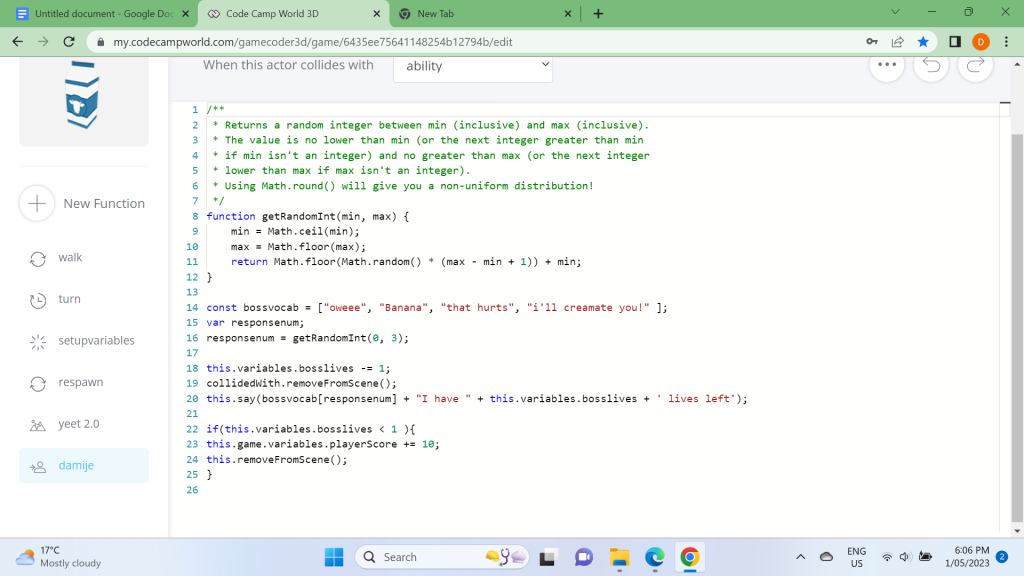
I went to a holiday program called codecamp and I made a game using java script which is a programming language. The game was 3d and had two levels before the main fight. This part is really hard for beginners as the enemy has ten lives and you only have 3, you fire arrows at a milk carton and the carton fires rubber duckies at you, fast. The coding was mostly quite simple (for me) as I do computer programming a lot. This was quite an interesting task for me as I don’t often do games, let alone 3d ones. After the
In the picture you can see with the two screenshots where the milk carton says “that hurts” and where in the program that is randomly selected from a list called bossvocab.
Over the school holidays I went to a drama and performance school for a week. The topic of the program was ‘rags to riches’ (personal growth, character development). I was in the year 3-6 level and there were 16 of us. On Friday that week I did a performance. I sung two songs:
You ‘ain’t never had a friend like me – Aladdin
It’s a hard knock life – Annie
We did numerous smaller group performances (4 groups of 4 mostly) all based on Cinderella and (again) Aladdin.
For our group performances we went through stages:
Mime
We had to start making the scene with no sound at all
One sound effect
We could add one sound effect to each character
Gibberish
We made the scene with words replaced with gibberish
Full sound
We made the scene with all of the lines and dialogue
It was great fun and I very much enjoyed it. I suggest that if you like doing performances check out the N.I.D.A program.
Crunchy and delicious, Anzac biscuits made with oats are cheap to make and are a lower GI alternative to many packet biscuits. Containing coconut, golden syrup and butter, these biscuits do not use egg as a binding agent.
Ingredients
2 cups rolled oats
2 cups plain flour
2 cups coconut
1 1/2 cups sugar
250 g butter
4 tbs golden syrup
1 tsp bicarbonate of soda
2 tbs boiling water
Method
Turn oven to 160°C. Lightly grease oven trays.
Place oats, flour, coconut, sugar in big mixing bowl.
Melt butter and golden syrup in saucepan. Take off heat.
Mix baking soda and boiling water in a cup. Add to melted butter mixture in the pan. Quickly add to big mixing bowl. Mix well.
Roll tablespoonfuls of the mixture into balls. Place on trays 5cm apart. Press lightly with fork.


:max_bytes(150000):strip_icc():format(webp)/Simply-Recipes-Easy-Banana-Bread-METHOD-1-8c3b632837ae49cfa57f1d49912d1271.jpg)
:max_bytes(150000):strip_icc():format(webp)/Simply-Recipes-Easy-Banana-Bread-METHOD-3-32fe590df70d4e1bb7a77aea94bd30e9.jpg)
:max_bytes(150000):strip_icc():format(webp)/Simply-Recipes-Easy-Banana-Bread-METHOD-5-a9a9c4e47f7a46e2adbf3b423606604a.jpg)
:max_bytes(150000):strip_icc():format(webp)/Simply-Recipes-Easy-Banana-Bread-METHOD-6-2e03de4b1a32468c84e8ecc491c267ef.jpg)